- Home
- Autumn Inspired
- Latest Releases
-
Brands
- Alumilite Resin
- Bunty's Paints
- Guild Lane
- Mint by Michelle
- Pentart Craft Supplies
- PolyOnlay Decorative Shapes
-
Redesign with Prima
- All Redesign with Prima
- All RWP Transfers
- Small Transfers
- Middy Transfers
- Maxi Transfers
- Large Transfers
- Metallic Transfers
- H2O Transfers
- Luxe Transfers
- All RWP Decoupage
- A1 Decoupage Papers
- A3 Decoupage Papers
- A4 Decoupage Papers
- 19"x30" Decoupage Papers
- Chalk Paste
- Décor Poly Flexible Appliques
- Gold Leaf & Gilding
- MelodyCast
- Mica Powder
- Silicone Moulds
- Stamps
- Wax
- Sophie James Decor Paint
- Three Yellow Goats
- Two Fussy Blokes Rollers & Brushes
- Zibra Brushes
- Products
- LWB Upcycled
- LWB Vintage
- Gift Cards
- How-To Guides
- Furniture Artist Focus
- Blog
- Join LWB Upcycled
- —
- Sign In
Furniture Artist Focus - Pinkyswifts
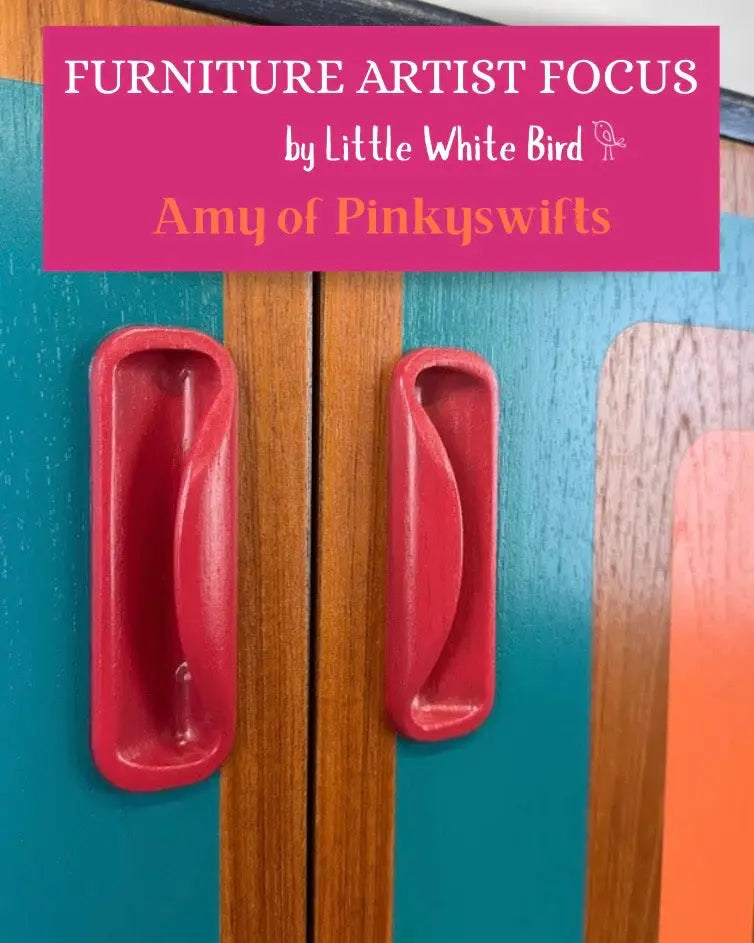 Colourful. Bold. Unmistakably Pinkyswifts.
Amy’s hand-painted furniture celebrates individuality, craftsmanship and sustainability. We caught up with her to talk about her journey from corporate life to creative business owner, her love of geometry and colour, and what goes into creating a truly unique piece.
Story & Background
What inspired you to become a furniture Artist?
I've always loved interiors and creating lots of different things for our own home so one day I decided to paint a design on a bureau and realised, I think I'm quite good at this ;)
Do you remember the first piece you ever transformed?
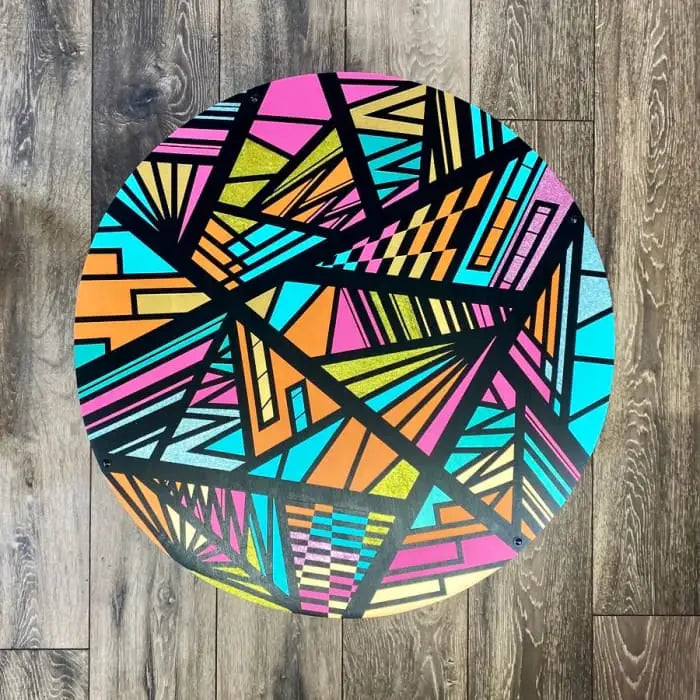
It was a fabulous mid century writing bureau we'd had for ages and I'd seen them converted into drinks cabinets so thought I'd give it a go. I knew I wanted to create a geometric triangular design and loved every minute of working out how to do it and strive for those clean lines.
What sparked the moment you knew this was something you wanted to pursue seriously?
I was in a high pressured corporate job, hit 40 and realised something had to give. Watching The Repair Shop one night I just turned to my husband and said 'I think I want to do that' - so I handed my notice in the next day and then started to work what I needed to do to combine my love of furniture, colour and painting. I really felt if I didn't try it then, I'd always be thinking 'what if?'.
Creative Style & Process
How would you describe your signature Pinkyswifts style? What elements make a piece instantly recognisable as yours?
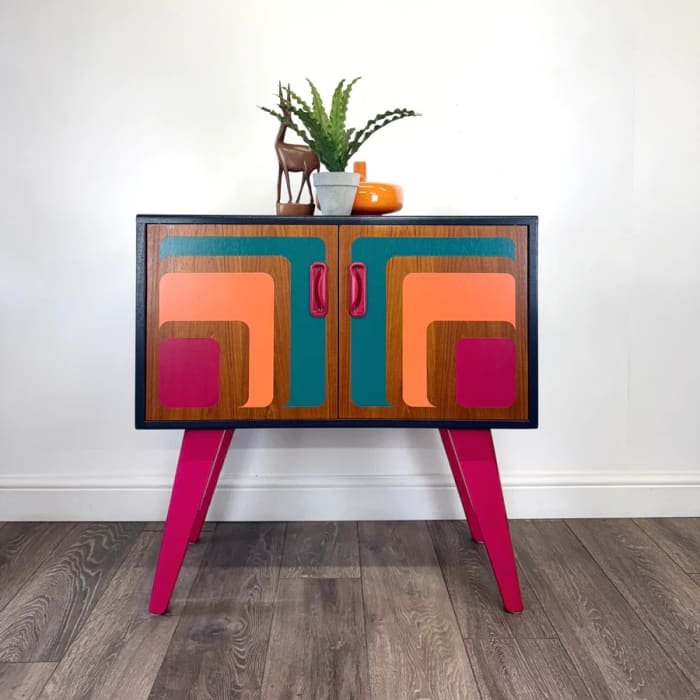
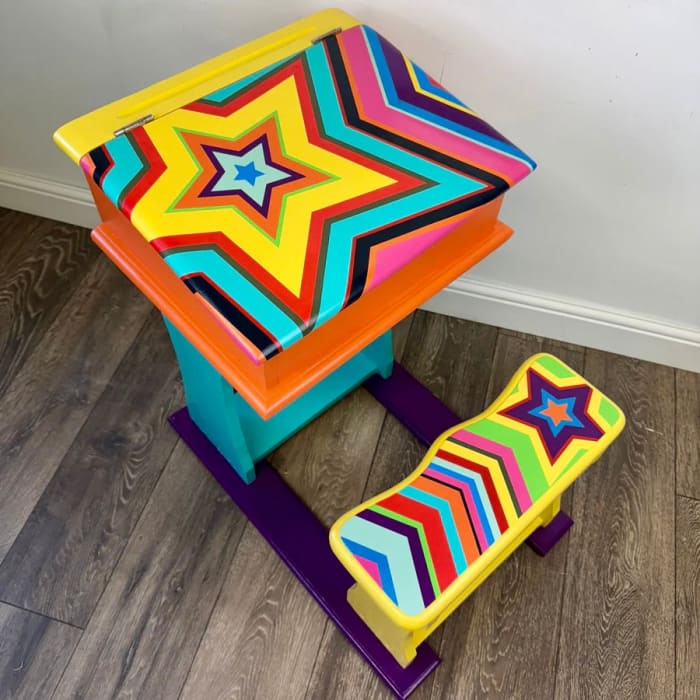
The more colours the better!! I'd say my style is colourful, bold, geometric and definitely a focal point for any room.
Colour is central to your work - how do you choose your palettes? Do you start with colour, shape, or the furniture itself? Are there particular colours you are drawn to?
I definitely start with the piece itself because you have to build the design and colours around not only how it looks but it's function. If for example the piece had really interesting wood, I'd work with the existing grain and colours to come up with a design that elevates it original features rather than working against them. I'm definitely drawn to bright, joyful colours that make me smile.
What role do geometry and pattern play in your designs?
My designs are handpainted and completely tailored to the shape and size of the furniture I'm working on, so being able to accurately measure and work out angles is essential. I'm much more drawn to asymmetry for my designs but do also love the challenge of creating a repeating pattern that has to be exactly the same across the whole piece.
My designs are handpainted and completely tailored to the shape and size of the furniture I'm working on, so being able to accurately measure and work out angles is essential. I'm much more drawn to asymmetry for my designs but do also love the challenge of creating a repeating pattern that has to be exactly the same across the whole piece.
How does your cabinet-making background influence the way you work?
When working on older furniture, there are usually varying degrees of repairs needed so I really wanted to be confident with what I was doing which is why I completed the HND in Cabinet Making. I means I'm able to not only repair but also offer suggestions if customers are looking to change the use of a unit or for example, I recently made an avocado-shaped table out of a 'donor' table I sourced for a customer. Sounds a bit bonkers (and was) but because of my training I was confident I could create exactly what he wanted.
When working on older furniture, there are usually varying degrees of repairs needed so I really wanted to be confident with what I was doing which is why I completed the HND in Cabinet Making. I means I'm able to not only repair but also offer suggestions if customers are looking to change the use of a unit or for example, I recently made an avocado-shaped table out of a 'donor' table I sourced for a customer. Sounds a bit bonkers (and was) but because of my training I was confident I could create exactly what he wanted.
Which part of the process do you enjoy the most - and which is the most challenging?
I absolutely love helping customers to inject colour into their homes, especially when they come to me not knowing where to start or how to go about it. Working with them to literally start from scratch on what works, what their style could be, how that translates to furniture for their home and then seeing the end result is fantastic. Older furniture is absolutely the best to work on but always come with it's own 'personality' and despite all the planning can often throw up challenges once you get started - that drawer that won't slide, the cupboard door that now doesn't hang properly ;)
Story Behind the Pieces
What makes a Pinkyswifts piece truly unique?
Each piece is tailored specifically to it's shape and design, the colours and pattern are used to elevate it's original form and especially with the most intricate designs, couldn't be replicated even if I tried.
Is there a recent piece that feels especially meaningful for you?
I worked on a customers cabinet that used to belong to her Grandma. It was highly carved and very dark wood so not her style at all but she really wanted to hold on to it as it held lots of childhood memories. We used a piece of wrapping paper she liked as the starting point for the colour scheme, worked with the shape and carvings highlighting different sections with colour, added a shelf to the bottom and even added her Grandma's surname on the inside in gold leaf.
How do you decide whether a piece has potential before you start working on it? What do you look for, structurally or visually?
First thing I look for is how it looks visually - is it suitable for a colourful design? Mid century furniture is usually my go to because it has clean lines and flat surfaces. Can I elevate the original form using colour and pattern? Then is it well made, 'good wood' not something that isn't going to last. If the structure of the piece isn't going to have longevity, it isn't going to last for the customer regardless of how fabulous I make it look.
First thing I look for is how it looks visually - is it suitable for a colourful design? Mid century furniture is usually my go to because it has clean lines and flat surfaces. Can I elevate the original form using colour and pattern? Then is it well made, 'good wood' not something that isn't going to last. If the structure of the piece isn't going to have longevity, it isn't going to last for the customer regardless of how fabulous I make it look.
Craftsmanship, Sustainability & Values
Why is working with vintage furniture important to you?
There is so much amazing furniture out there just waiting to be made fabulous again. It is better quality, has much more style and potential to be individual that I would always encourage customers to buy vintage rather than new, generic boring pieces.
How do you see the future of upcycled furniture?
I'd like to think that people that value individuality, style and sustainability recognise that upcycled furniture ticks all those boxes and start to fully embrace it as part of their interiors. I'm seeing more and more customers be very mindful of what they want to have in their homes and that upcycled furniture is not only the sustainable option but one that can reflect their individual personality.
What do you wish more people understood about the work involved in restoring and transforming furniture properly?
I think the time and expertise in preparing a piece of furniture is one of those things that can be hard to understand because you don't see it in the finished result. It can take days to strip/sand/repair etc a piece before you even pick up a paint brush but it is absolutely essential to make sure you have the best foundations for the design to ensure longevity and a professional finish for your customers.
I think the time and expertise in preparing a piece of furniture is one of those things that can be hard to understand because you don't see it in the finished result. It can take days to strip/sand/repair etc a piece before you even pick up a paint brush but it is absolutely essential to make sure you have the best foundations for the design to ensure longevity and a professional finish for your customers.
For Customers
What kind of homes and people are your pieces designed for?
For people who want to inject colour into their homes but perhaps aren't quite sure where to start. For those who want something completely tailored to them and is a sustainable alternative to anything mass produced.
Any advice for someone nervous about injecting bold colours into their home?
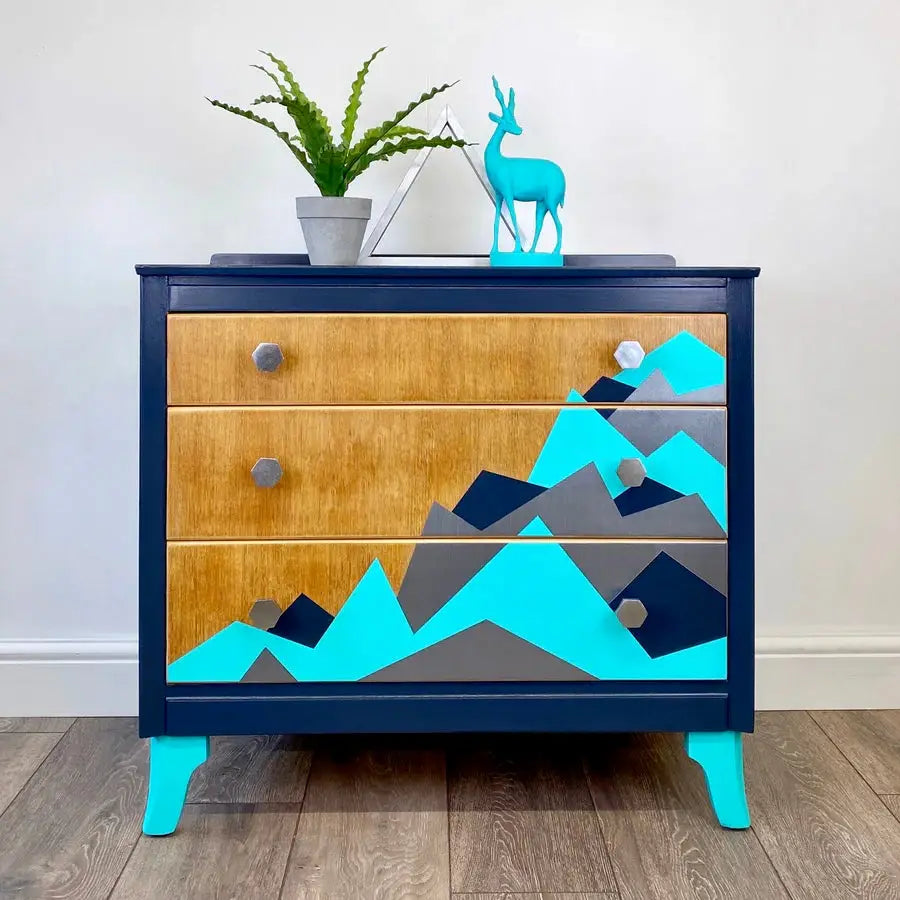
Start small, think about colours you like or use a piece of art you love as a starting point. You can then start to build up a colour palette that uses a combination of bold colours and more classic to help gradually adding colour ie bright teal and hot pink look great with a gorgeous deep navy.
Start small, think about colours you like or use a piece of art you love as a starting point. You can then start to build up a colour palette that uses a combination of bold colours and more classic to help gradually adding colour ie bright teal and hot pink look great with a gorgeous deep navy.
How should customers care for a Pinkyswifts piece to keep it looking it's best?
I'd always suggest using coasters for tables and when cleaning just use a soft, slightly damp cloth just to ensure any sort of polish doesn't affect the paint finish but it really isn't that different to any other furniture you own. And don't forget, it's there is be used and enjoyed ;)
I'd always suggest using coasters for tables and when cleaning just use a soft, slightly damp cloth just to ensure any sort of polish doesn't affect the paint finish but it really isn't that different to any other furniture you own. And don't forget, it's there is be used and enjoyed ;)
What does owning an upcycled statement piece offer that buying new can't?
Individuality!!! It really can be exactly what you dream of - colours, designs, shape/size you name it and all done with sustainability at it's heart.
Looking Ahead
What are you excited to work on next?
I've got a fantastic nest of mid century tables for a customer who has a house full of pieces she bought during the 70s and is now wanting to bring colour in. She's very open to lots of colours and shapes so I can't wait to get started!
Do you have any dream projects or collaborations?
I'd love to work on the furniture for something big like a bar or small hotel creating really 'out there' pieces.
Where do you see Pinkyswifts evolving over the next few years?
Over the last couple of years I've started to run workshops and have seen a real excitement from people wanting to paint their own furniture. It's the perfect way to help people inject colour into their homes and share all things upcycling, literally my favorite thing! I'd like to expand on the different workshops I run and also look at creating more homewares and accessories.
Our thanks to Amy of Pinkyswifts for such a fabulous insight into her motivations and creative process.
You can explore Amy’s available pieces and learn more about her work as part of LWB Upcycled. Follow us on social media to keep up with Amy’s latest creations as they become available.